You will fall down on the floor if you lose your balance or if any force from the outside moves your body away from the center of your balance axis. How to avoid that? You need to know where your balance point is and how to keep it.
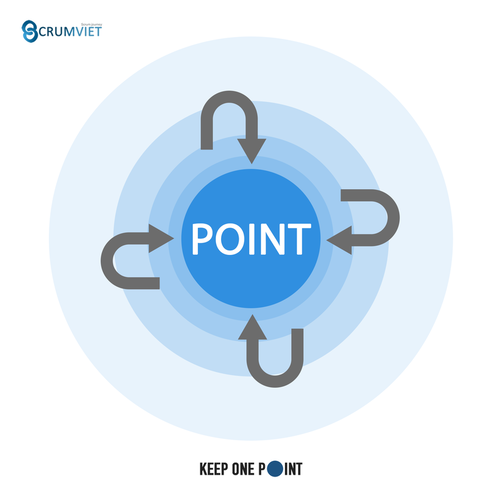
When I practiced Aikido a few years ago, my master taught me a principle to keep my balance: “Keep one point” (The point in this context: “It is a spot in your lower abdomen, a couple of inches below your belly button. It is roughly the same place as your center of mass.”). The reason why they use the word “keep”, because you can lose the “point” suddenly like someone pushes you down, you tripped over by the rocks and fall…, or even with intention like when you want to walk, the movement of your body, your hands, your legs, that’s the combination of the intention to make you lost the point of your balance and move the point back to walk forward.
“Keep one point” helps me to connect my mind to the center of balance in my body. Once I “Keep one point”:
* I will be stronger because I know where my point of balance is.
* Difficult to be pushed down, because I know how to move back to the point (get back the balance).
“Keep one point” with me is not only for Aikido, but it also helped me to keep the balance and focus in my life. I learned that everything has a point: a core value, the principle, the “Why”. Understanding and keeping that “point”, my principle, will help me to have balance, to make the right decisions in everything I do.
Today, I would like to link “Keep One Point” to the Scrum Master position. Many Scrum Masters ask for advice on how they can deal with tough situations like: Should I solve the conflict for the team? Or should I step back? How can I remove this impediment? How can I talk with the CFO about his/her decisions as it impacts the team’s self-management? And more… All of those are complex questions. To have the answers to those questions, we need to know more about the context. And the people who have the best answers are also the people who asked those questions. To deal with those challenges, you need to know what the principle (“Point”) of the Scrum Master is and keep it. Once you keep the principle, you will know the “how”. Rather than looking for short-term consult or advice.
The new Scrum Guide 2020 mentions Scrum Master:
Scrum Masters are true leaders who serve the Scrum Team and the larger organization.
– Scrum Guide 2020
This is a principle you need to keep; you are the True Leader. You serve the Scrum Team and the larger organization. Every time you have something that needs to be decided, you think about that principle. It will help you to answer your questions: does that impact the team’s self-management? Does that help the team to grow? Any impediments will happen; do I need to remove them, or can the team try to learn? Am I only focusing on the team but lacking care about the organization? Is my decision far away from the principle of the Scrum Master that I need to keep? How can I move back to the principle?
All your decisions, everything you do, needs to serve one purpose, as the Scrum Guide mentions:
“The Scrum Master is accountable for the Scrum Team’s effectiveness. They do this by enabling the Scrum Team to improve its practices within the Scrum framework.”
– Scrum Guide 2020

In Aikido, I learn to “Keep One Point” by focusing and thinking about the point of balance every day, while driving, walking, eating, reading, anytime. The purpose is to build the habit so it becomes my subconscious. When “Keep One Point” becomes my subconscious, I can keep the point of my balance every time with no effort. Like a Scrum Master (or anything you want to master in your life), you need to understand what the principle of a Scrum Master is and the values. Build awareness in your mind about that principle, and practice it until it becomes subconscious. Accompanied by building awareness and practicing, anything you do will be around that principle (even sometimes you get lost or move far away from the principle, you will know and move it back). The principle will help you balance and be a great Scrum Master, deal with the challenges to serve the Scrum Team and organization. Day by day, once you master it, your subconscious mind will lead you; at that stage, you will take no effort to keep the principle; it becomes natural.
Scrum on!