As Product Owner, how do you deliver value to your Customer/End-User? To know what value is, you need to validate it. To validate your value, you need to know who your Customer (End user) is. I asked that because identifying your end user is very important. If you don’t know who your real customer is, how can you build a product to make them happy? Or you will make no one happy; no happy customer means no business, right?
Let’s go through 3 Situations below:
1. End-user is Customer
You build the product; your customers are the people who use that product, and your revenue comes from them. So your Customers are your End-Users.

These are the Ultimate Customers you need to take care of and understand what is the best value you can bring to them.
Therefore, focus and bring happiness to End-users. Treat them if they are not happy, and bring them more values with new features.
2. Internal Customer
In some cases, you develop a product or service for the needs of Internal Customers and they will become a producer for Ultimate Customers/ End-Users.

If Internal Customers understand and have a strong connection with Ultimate Customers/End-Users, it’s all good. What if internal customers are disconnected from Ultimate customers/ End-Users? And the needs of Ultimate customers/End users are not being satisfied? All your effort will be wasted.
In any case, the Ultimate customer/ End user must be happy. So you should not only develop a product or service for the needs of the internal customer, but also have data (evidence) on which values make Ultimate customers/End users happy to build the right thing.
3. The customer is not an end user
This is an interesting situation when your Customer is not an end user. You develop a product for End-user use, but you get revenue from other Customers. In this case, you need to make both of them happy.

E.g: Facebook can be an example; end users use Facebook to share and make friends. But revenue comes from ads.
It’s not easy to satisfy Customers and end users at the same time. So it depends on your data (evidence) or vision; you can order your backlog and decide when to treat or bring more value to each.

User Story Mapping
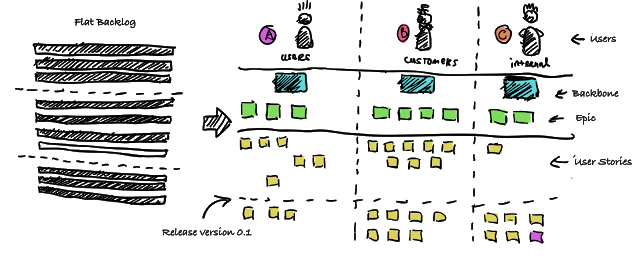
One of the tools I love to use is User Story Mapping; from that, I lay out separately which ones are for Customers, which are for End users, and even which are for Internal Customers. It will be easier to order the Product Backlog.
#Scrum #Product #Productbacklog #Values